The Modest Case: British Watch Buying Moves Toward a Quieter Wrist
For much of the past decade, the British luxury watch buyer was encouraged to think in terms of presence. The dial had to announce itself across a room; the case had to carry the weight of a sports watch even when the nearest body of water was a lido in July. In 2026, that instinct is being quietly revised. The interesting movement in UK watch buying is not toward the louder statement but toward the smaller, warmer, more considered case — often in the region of 34mm, and almost always chosen with the rest of the wardrobe in mind.
This is not a rejection of sportiness, nor a sudden conversion to antique manners. It is a correction. British dress has loosened, but it has not become careless. Shirt cuffs are still worn, knitwear is still layered, and jewellery is still allowed to speak. A watch that once seemed exciting in isolation can begin to feel overbearing when set against a suede jacket, a signet ring and a Oxford shirt that actually fits. The smaller watch answers that tension without fuss.
Why the wrist changed its mind
The shift is partly practical. British buyers are more informed about case dimensions than they were a few years ago. Forums, dealer conversations and a fuller secondary market have taught people to ask about lug-to-lug length, case thickness and dial aperture rather than diameter alone. A 34mm watch with long lugs can wear larger than a 36mm watch with a compact case; a thick bezel can make a modest dial feel cramped. The number on the specification sheet is only the beginning of the story.
There is also a cultural reason. The UK’s most persuasive style references — the tailored coat, the well-cut shirt, the inherited ring, the slightly worn leather strap — tend to reward restraint. A smaller watch sits inside that grammar. It suggests that the wearer has nothing to prove, which is usually the point of luxury in the first place.
Proportion is not a number
The useful rule is not “34mm for everyone” but “measure the wrist and watch the whole case”. Start with wrist circumference and the shape of the wrist: a flat wrist can carry a wider case; a round wrist often suits a shorter lug-to-lug. For many wearers, a 34mm case with a lug-to-lug of roughly 40–43mm will sit comfortably, while a 36mm case may run to 44–45mm and still feel balanced. On a 15–16cm wrist, 32–34mm is often the sweet spot; on 16–17cm, 34–36mm; above 17cm, 36–38mm becomes viable. These are starting points, not laws.
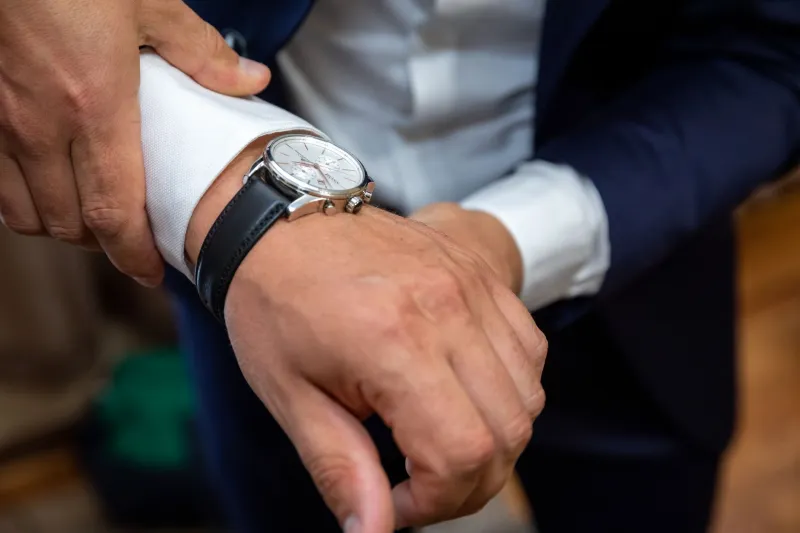
Thickness matters as much as width. A slim case slips under a cuff and disappears beneath a knit; a tall case catches on both. If the watch is to be worn with tailoring, check how it behaves under a shirt cuff before buying. If it is to be worn with short sleeves, check how the lugs sit against the edges of the wrist. A watch should not overhang the wrist bone, and it should not force the cuff into a permanent bulge.
The cuff, the knit and the bracelet
British weather makes layering a daily consideration. A smaller watch is easier to wear under a lambswool crew neck, a brushed cotton shirt or a raincoat sleeve. It also leaves room for jewellery. A 34mm watch and a fine gold bracelet can coexist on the same wrist if the bracelet is not too heavy and the watch sits high enough; the effect should look accumulated rather than staged. Metal-matching is optional, but the combination should be intentional. A steel watch with a yellow-gold ring is not a mistake; a steel watch, a chunky gold bracelet and a silver cuff on the same wrist is simply too many arguments.
For those who wear a watch on one wrist and a bracelet on the other, proportion still matters. A smaller case balances a signet ring or a chain without competing. It also makes a leather strap look less like a costume and more like a habit.
Metals, straps and the British climate
Steel remains the quiet default, but warmer metals are doing more work in 2026. Yellow gold reads well against navy, grey and olive; rose gold is less strident than it once was; white gold and platinum disappear into a cuff in the most discreet way. The metal should suit the wearer’s jewellery, not necessarily match it. Tone and temperature matter more than an exact alloy.
Straps deserve equal thought. A slim leather strap in a muted brown or black is the obvious choice for tailoring, but British damp punishes untreated leather. Suede is handsome and impractical in equal measure. A steel bracelet with a micro-adjust clasp is the most useful year-round answer, especially on a smaller case where the bracelet must taper neatly. Rubber is fine for sport, but it can make a modest watch look confused if the rest of the outfit is formal. Above all, the strap should be proportionate: a 20mm strap on a 34mm case can overwhelm the dial, while a well-tapered 18mm strap can make the whole watch look more expensive.
Vintage-informed, not vintage-imitation
The smaller watch has revived interest in vintage-informed design, but British buyers should be clear about the difference between honest inspiration and invented heritage. A new watch may legitimately borrow a sector dial, a box-shaped crystal or a small seconds register. What it should not do is invent a founding date, claim a fictitious military past or dress artificial patina up as history. Faux ageing is easy to spot at close range: the lume is too even, the case too crisp, the story too convenient.
For genuine vintage, buy the seller as much as the watch. Ask about service history, replacement parts, refinished dials and polished cases. A “Franken” watch assembled from unrelated components is not a bargain; it is a liability. Reputable UK dealers and auction houses will disclose what they know, and a specialist watchmaker can confirm whether the movement, case and dial belong together. The same discipline applies to modern vintage-inspired pieces: check the movement, the warranty and the water resistance rather than paying a premium for atmosphere.
A quieter signal
The 34mm watch is not a rule to be imposed on every wrist. It is a useful measure of intent. In 2026, the British buyer who chooses a smaller case is often the one who has thought about the cuff, the ring, the coat and the weather — and has decided that luxury need not be loud to be legible. That is a more sophisticated signal than size alone, and it is likely to age better than any oversized case ever could.