The Small Pin Principle: Why British Lapels Have Gone Quietly Sculptural
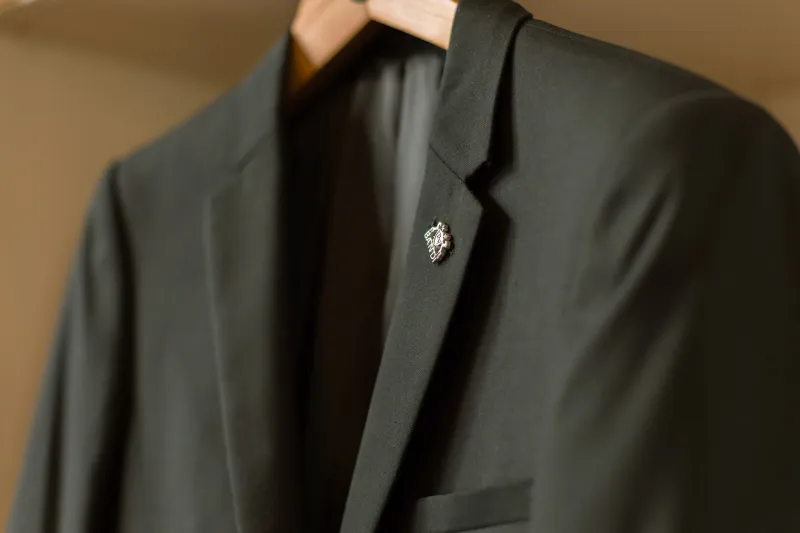
Walk through Bath, Leeds or a leafier corner of north London on a cold morning and the same small gesture repeats itself: one pin, no larger than a thumbprint, sitting slightly off-centre on a heavy wool coat. This is not the return of the grand statement brooch. It is close to the opposite — a deliberately modest flourish, worn by people who would rather be asked about a piece than have it announce itself across a room.
Why the pin, and why now
Three things have converged. First, coats have become the main event of a British winter wardrobe again, and a coat with a clean lapel is an invitation. Second, knitwear has moved outward — a fine-gauge crew neck is now outerwear for a great many people, and a pin gives it a focal point without a necklace. Third, and most importantly, the mood in British jewellery has swung decisively towards the small and the sculptural: fewer stones, more form, more metal doing the work.
There is a practical reason too. A pin is the most forgiving piece of jewellery a person can own. It does not need to fit. It does not need to be sized, layered or matched. It works on a lapel, a scarf, a bag strap or a coat collar, and it can sit unworn in a drawer for a decade without tarnishing the way a chain will.
The four-centimetre rule
Treat four centimetres as an outer limit for daylight wear. Below two centimetres, a pin reads as a detail rather than an accessory — useful if you want the effect to be noticed only on the second look. Between two and four centimetres is the sweet spot: enough mass to catch the light, not enough to weigh down a lapel or pull at a knit.
Width matters as much as height. A long, narrow bar sits well on a peak lapel; a compact, roughly circular form suits a notch lapel or a crew neck. Anything wider than the lapel itself will look as though it has been pinned on rather than placed.
Placement, in practice
- Coat lapel: at the notch, or a centimetre above it, on the left. Higher reads as formal; lower reads as casual.
- Knitwear: high on the chest, no more than a hand's width below the collarbone, or on the shoulder seam of a heavy cardigan.
- Scarves and shawls: at the shoulder, used functionally to hold the fold. This is the oldest use of the pin and still the most convincing.
- Bare collars: on a shirt worn without a tie, keep it small and place it off-centre. A pin at the exact centre of a collar reads as uniform.
One pin is nearly always enough. Two works only when they are deliberately paired and identical in scale; three is a collection, not an outfit.
Seven British sources worth your attention
Completedworks. The London studio's sculptural silver and gold pieces are the closest thing the market has to a house style for the small pin: folded, curved, occasionally slightly absurd, always light enough to wear on a fine knit.
Bleue Burnham. Botanical casts in recycled gold and silver, made in small runs. The naturalistic detail is precise rather than whimsical, which is the difference between a piece that lasts and one that dates.
Alighieri. Irregular, hand-finished surfaces that look as though they have been dug up rather than bought. Best deployed on a heavier coat, where the texture has something to push against.
Annoushka. For those who want a pin with a mechanism — detachable drops, interchangeable elements — without the result looking like a gadget.
Solange Azagury-Partridge. Bolder in colour and proportion, and the reliable answer when a plain black coat needs one precise point of interest.
Theo Fennell. The workshop approach at its most traditional: figurative pieces and enamel work, made to commission if you want something that will not be seen on anyone else.
The archive route. For value, the auction houses and provincial salerooms remain excellent. Mid-century Scandinavian silver pins and Victorian sentimental pieces can be had for the price of a mid-range high-street chain, with the added reassurance of an assay office hallmark.
How to avoid the costume-box look
Avoid anything that mimics an object too literally — miniature instruments, animals with moving parts, anything with a diamanté cluster. Avoid pins whose only virtue is that they are large. And avoid pairing a pin with a necklace of similar weight at the same time; one focal point is the whole point.
The most common error is scale without restraint elsewhere. A small, well-made pin on a plain coat looks considered. The same pin on a coat already carrying a scarf, a tote and a visible label looks like an afterthought.
Fastenings, hallmarks and the practical side
A proper pin catch — the kind with a rotating safety collar — is worth insisting on. Roller catches and simple hook fittings loosen with wear, and a heavy pin on a fine knit will find the yarn before long. If a piece you love has a weak fitting, any competent jeweller can replace it for a modest sum.
Check the hallmark. UK-assayed silver, 9ct and 18ct gold will carry one; plated brass will not. On knitwear, a pin heavier than about ten grams will drag the shoulder out of shape over a season.
The long view
The reason this small flex has stuck is that it rewards judgement rather than budget. A £60 silver pin placed well will do more than a £3,000 piece worn badly. Buy one, wear it on everything for a winter, and you will know by spring whether the habit is yours.