The Composed Ear: Britain’s New Grammar of Piercing and Proportion
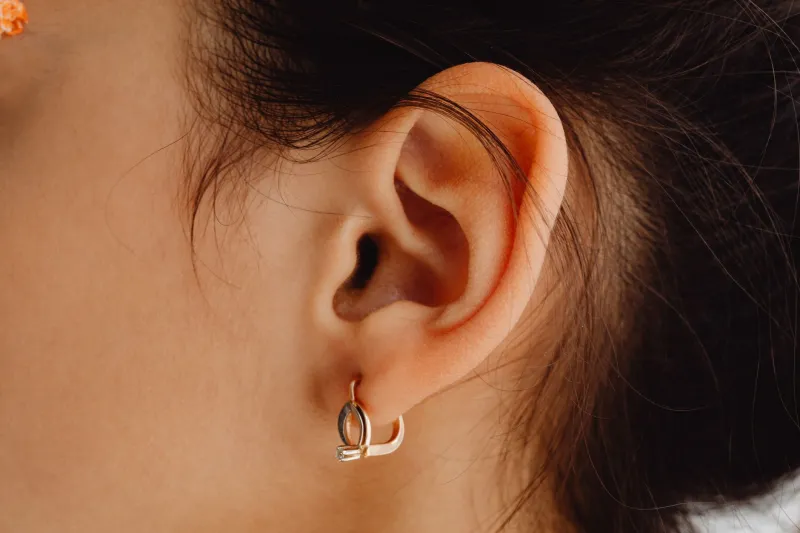
For years, earrings arrived in pairs and were treated as a matching exercise: one earring, then its twin, then a second pair for evening. The British ear of 2026 is a different proposition. It is read as a small architectural project—an arrangement of holes, metals and silhouettes that should look resolved whether the wearer is in a meeting, on the Tube or at dinner. The shift is not simply about acquiring more jewellery. It is about learning to compose.
The change is visible in the fitting rooms at Liberty of London, where Maria Tash’s studio has helped normalise the idea of the curated ear, and in the independent piercing rooms clustered around Marylebone and Shoreditch. It is also evident on the high street, where British brands now design huggies, tiny studs and ear cuffs explicitly to be worn together rather than sold as solitary statements. The result is a more patient, more personal way of buying jewellery—one that rewards restraint as much as enthusiasm.
An anatomy lesson, not a shopping list
The curated ear begins with anatomy. A piercer’s first task is not to sell a ladder of holes but to assess the fold of the helix, the depth of the conch and the angle of the lobe. Placement that suits one ear may sit awkwardly on another, and the most convincing compositions are usually the ones that follow the natural architecture rather than fight it.
London studios tend to advise the same sequence: begin with the lobe, add one cartilage piercing, and live with both before committing to more. The first lobe heals relatively quickly; cartilage takes considerably longer, often six to twelve months, and patience is not optional. A second or third lobe piercing can be added once the initial set has settled, while the conch, rook, tragus, daith and forward helix should be considered individually rather than as a collection to be completed in a single sitting.
Proportion matters as much as placement. A small stud near the face, a medium hoop at the first lobe and a finer line of metal further up the ear will read more clearly than a cluster of similarly sized pieces. Negative space is part of the design. The best curated ears are legible from a metre away: the eye understands where the weight sits, where the line travels and where it stops.
Metal, gauge and the discipline of restraint
The British market has settled, broadly, on yellow gold as the dominant tone, with white gold and rose gold used as accents rather than equal partners. Mixing metals can work, but it works best when one tone leads and the others support. A warm gold hoop beside a single white gold huggie reads as deliberate; four competing tones read as noise.
Gauge is the quiet technical decision that separates a polished ear from a merely full one. Most fine earrings sit at 18g or 16g, and the difference is visible in the delicacy of the metal. Huggies typically range from about 6.5mm to 9.5mm in diameter, with smaller diameters suited to upper-lobe and cartilage placements and larger hoops reserved for the lobe. Ear cuffs, which require no piercing, are useful for testing a composition before committing to it—and for adding a sculptural line without another healing period.
Restraint is the harder discipline. The temptation, once the first few piercings have healed, is to keep adding. But a composed ear is not a crowded ear. Many of the most assured examples in Britain today use four or five placements, carefully spaced, rather than a dense run of metal from lobe to helix. The aim is balance, not accumulation.
What the studios advise
Professional piercers in London are consistent on aftercare: sterile saline, clean hands, no twisting, and no sleeping on the healing side. Cartilage piercings are slow to settle and prone to irritation, so downsize jewellery once swelling has subsided and avoid changing pieces before the piercing is fully healed. A piercer’s job is anatomy and aftercare, not ambition; a reputable studio will talk a client out of a placement that is unlikely to heal well.
That advice extends to the buying decision. A curated ear is built over time, often across a year or more, and the jewellery should be bought with healing and wear in mind. Solid gold is the more sensible long-term investment for pieces intended to stay in for months at a time; plated metals are better suited to occasional wear and ear cuffs. The cost per wear of a small solid-gold huggie, worn daily for years, is often lower than that of several trend-led pieces that tarnish or lose their finish.
The British edit
British brands have responded to the curated ear with pieces designed to layer rather than dominate. The following are worth considering as building blocks rather than one-off purchases:
- Otiumberg: London-based and family-run, with a strong line in solid-gold huggies and tiny studs suited to second and third lobes.
- Missoma: accessible gold hoops and studs in graduated sizes, useful for establishing a consistent line.
- Monica Vinader: fine diamond earrings and stackable styles, with engraving options for personalisation.
- Astley Clarke: delicate diamond studs and hoops that sit comfortably in cartilage placements.
- Dinny Hall: classic British goldsmithing, with hoops and studs that work as long-term anchors.
- Shaun Leane: sculptural pieces for the wearer who wants one stronger gesture within a quieter composition.
- Completedworks: irregular pearls and organic forms for those who prefer texture to uniformity.
- V by Laura Vann: architectural, deco-inspired studs and cuffs that add line without weight.
- Rachel Jackson: playful, character-led pieces for the upper ear, best used sparingly.
A collection that ages
The curated ear is, in the end, a slow form of collecting. It rewards buyers who think in years rather than seasons, who choose pieces they are happy to wear every day, and who understand that a composition can be resolved without being finished. The ear changes as the collection grows, and the best edit is the one that still looks considered when one piece is removed.
That is the quiet pleasure of the movement: not the number of piercings, but the confidence to stop. A composed ear is a personal grammar—placement, proportion, metal and restraint—and like any good sentence, it is improved by knowing where to put the full stop.