The Shrinking Season: What British Ring Buyers Get Wrong About Winter Fittings
A ring bought in the coldest week of the year has a particular way of betraying its owner later. It may leave the shop feeling exact, then turn on the finger by February; or it may be sized in a chilly moment and become uncomfortably tight by July. The problem is not careless measuring so much as a misunderstanding of what a finger actually is: a living, variable part of the body, not a fixed measurement like a wrist or a collar. In Britain, where a cold walk to the Tube, an overheated office and a hot bath can all occur within the same afternoon, that variability is especially pronounced.
The Ice List spoke to jewellers and bench workers in London, Birmingham and Edinburgh about the seasonal sizing problem. Their advice was consistent, and slightly inconvenient: the best ring size is rarely the one taken in a single appointment, in a single temperature, on a single finger. It is a considered range, confirmed over time and adjusted with the help of a workshop that understands how metal, stones and daily wear behave.
Why a December Finger Lies
Fingers respond to temperature long before the wearer notices. In the cold, blood vessels near the skin constrict and the fingers narrow; after twenty minutes indoors, particularly beside a radiator or under a hot drink, they swell again. A showroom is usually warm. A December fitting may therefore capture a finger at its more generous end, producing a ring that feels secure beneath the shop lights but spins on a cold platform at Charing Cross.
The reverse is just as common. A buyer who walks in from a freezing street, removes a glove and asks to be measured immediately may be fitted to a smaller size than the finger will accept in summer. The result is a ring that behaves well in winter and becomes a source of quiet discomfort during a warm spell. Add central heating, salty meals, alcohol, exercise and the natural difference between the dominant and non-dominant hand, and the idea of one immutable size begins to look optimistic.
Bench workers tend to speak less about a single correct measurement than about a sensible compromise. A ring should clear the knuckle without requiring soap or force, sit securely enough that it does not slide off when the hand is cold, and remain comfortable when the finger is at its warmest. For many buyers, that means choosing a size that is very slightly generous in winter and planning for a sizing bead or a minor adjustment later, rather than insisting on a snug fit in December.
The Bench View: What Resizing Really Costs
Resizing is not a failure of judgment; it is part of the life of a ring. In 2026, a straightforward downsize at a UK workshop commonly falls between £45 and £95, depending on the metal, the construction and whether the band is plain or set with stones. Upsizing is more variable: a small increase may be possible by stretching, but a larger increase often requires cutting and inserting metal. Platinum and white gold add cost and complexity, and a full re-shank can run from £150 to £300 or more. Sizing beads, fitted inside the band to reduce movement without altering the outer profile, are usually £25 to £60.
The caveats matter as much as the prices. Full eternity rings, channel-set bands, very thin shanks and some alternative metals are difficult or impossible to resize without compromising the design. A jeweller in Birmingham's Jewellery Quarter put it plainly: the most expensive resize is the one that should never have been attempted. Buyers considering a surprise purchase should ask, before money changes hands, whether the ring can be altered, how many sizes it can move and whether the first adjustment is included.
Turnaround is another winter pressure. A simple resize may take three to ten working days, but December is not a quiet month for any workshop. A ring left until the week before a proposal may not return in time, and rush charges are common. The bench workers' preference is unambiguous: buy a ring that is close enough to wear, confirm the size afterwards, and let the workshop make a measured adjustment when the pressure of the moment has passed.
The Surprise-Proposal Problem
The coldest week of the year is, for reasons of romance and calendar convenience, also a popular week for proposals. It is also the week in which secret ring buying is most likely to go wrong. A partner's ring borrowed from a jewellery box may be a summer ring, a ring worn on another finger or a ring inherited from someone with different hands. A guessed size based on glove size is little better than a guess based on photographs.
The honest advice from jewellers is not to pretend certainty. If the proposal must remain a surprise, choose a style that can be resized, avoid a full eternity band and leave engraving until the size is confirmed. A slightly larger ring, worn temporarily with a discreet sizing bead or a soft adjuster, is a more graceful solution than a ring that will not pass the knuckle on the night. Where possible, ask the jeweller to note the intended size and hold the first resize at a fixed price. The proposal is the event; the fit is an administrative detail that can be corrected.
A Better Way to Measure
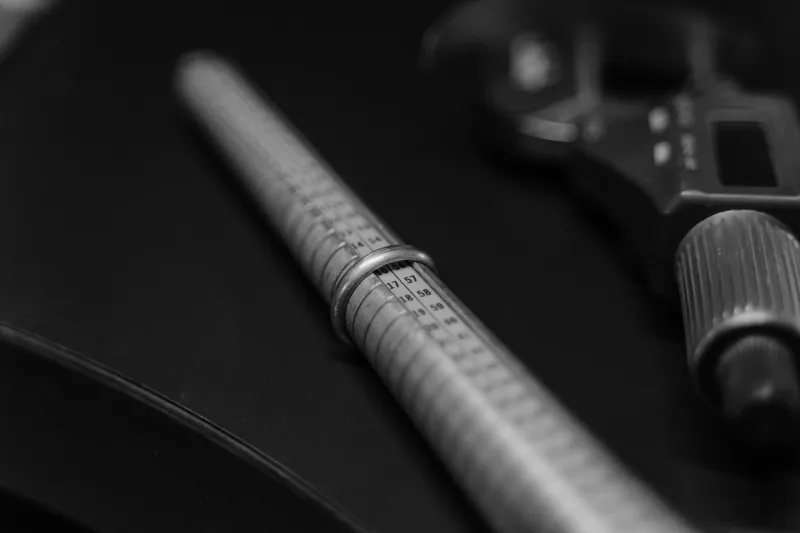
A more reliable fitting begins with time and neutrality. The buyer should arrive at the appointment having been indoors for at least twenty minutes, neither straight from a cold street nor immediately after exercise. The end of the day is generally better than the morning, when fingers are often slightly narrower. The dominant hand should be measured, and the ring gauge should be tried over the knuckle, not merely rested on the base of the finger. A wide band will feel tighter than a narrow one of the same declared size, so the two should not be treated as interchangeable.
It also helps to measure more than once. A professional fitting, a second opinion a week later and a check against an existing ring that fits well will reveal more than a single number. If the buyer is between sizes, the decision should depend on the design: a plain band can be sized down later with relative ease, while a stone-set band may be better purchased slightly larger and fitted with beads. The aim is not to eliminate movement entirely, but to ensure that the ring stays on the hand and remains comfortable across the year.
The Reasonable Expectation
A ring that spins slightly in February is not necessarily the wrong size. It may simply be a ring worn by a warm-blooded person in a cold country. The mistake is to treat a winter fitting as conclusive and to ignore the evidence of the rest of the year. British buyers would do well to ask a jeweller not only 'What size am I?' but 'What size should this ring be, given how and when I will wear it?' The answer may include a resize, a pair of sizing beads or a deliberate choice of a slightly different design.
At The Ice List, the view is that good jewellery buying is rarely about a single perfect decision. It is about understanding the material, the making and the ordinary conditions of wear. A ring is worn through central heating and cold platforms, through summer swelling and winter shrinkage. The most confident purchase is the one that leaves room for that reality — and a bench worker who can quietly correct it later.