Ice, Uncut: How Rock Crystal Became Britain’s Most Interesting Cold-Weather Stone
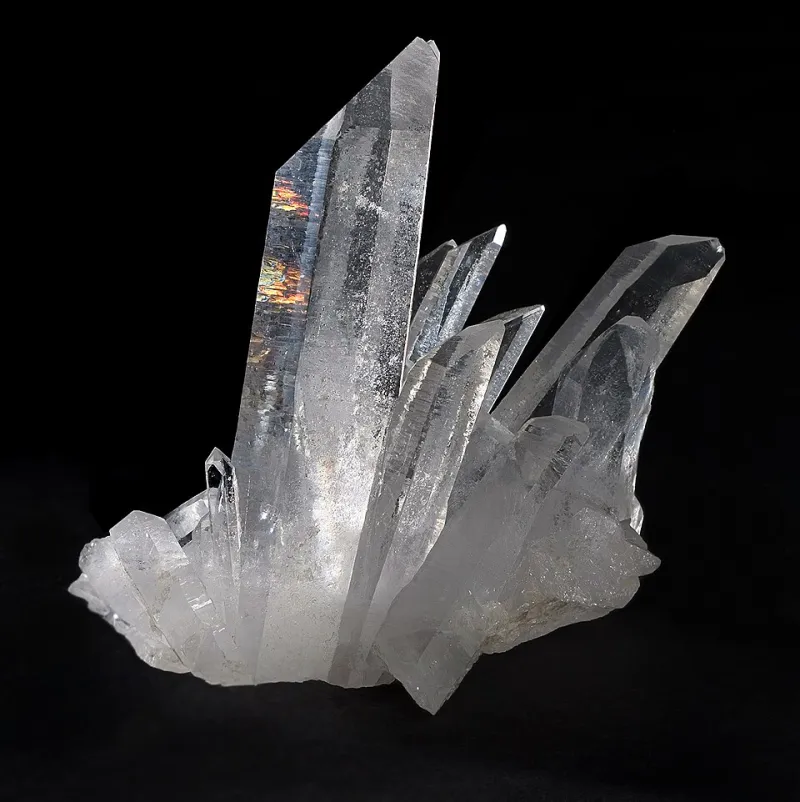
Photo: JJ Harrison (https://www.jjharrison.com.au/), CC BY-SA 2.5, via Wikimedia Commons
The winter jewellery conversation in Britain has a default setting: diamond. It is the stone the market reaches for when the nights draw in, the invitations accumulate and the case for something brilliant is made on the grounds of sheer, reliable sparkle. That case remains sound. But it is no longer the only one worth hearing. Across independent workshops and a growing number of fine-jewellery studios, rock crystal — clear quartz in its natural, uncoloured form — is having a quiet, well-argued moment. It is not a diamond substitute, and the makers using it are careful to say so. It is something more interesting: a stone with presence, a long history in British jewellery and a particular affinity for the grey, low-light months.
A Stone With a British Past, Not a Bridal Future
Rock crystal is not a novelty. Victorian and Edwardian jewellers set carved quartz into brooches, pendants and mourning pieces; Art Deco designers used faceted clear quartz for its architectural clarity, often pairing it with black enamel or onyx. In Scotland, clear quartz appeared alongside agate and cairngorm in traditional pebble jewellery, where it was valued for its local character rather than its price. What has changed is the context. A stone once associated with grand houses and museum cases now sits comfortably in the contemporary British fine-jewellery market, where buyers are more willing to ask what a piece is doing rather than simply how much it cost.
The distinction matters because rock crystal is often marketed badly. It is either pushed as a budget diamond — which it is not — or dressed up in bridal white, which flattens its character. The strongest work being made in Britain at present treats it as a material in its own right: a stone that can be carved, faceted, left with visible inclusions or polished into a smooth cabochon. Its appeal is not that it looks expensive. It is that it looks deliberate.
Why the Independents Are Returning to It
The commercial logic is straightforward. Rock crystal is materially softer than diamond and considerably less costly, which gives a designer freedom to work at scale. A large faceted pendant or a bold carved ring can be made without the stone budget dominating the piece. That allows independent jewellers — particularly those working in Birmingham’s Jewellery Quarter, Hatton Garden and the smaller studio networks in Edinburgh, Glasgow and Manchester — to experiment with proportion and setting in ways that would be difficult with precious stones at the same size.
There is also a design argument. Clear quartz takes a polish well and holds a crisp facet edge, so it suits the current British interest in sculptural, clean-lined jewellery. It can be set in brushed gold, darkened silver or platinum without looking underpowered. And because natural rock crystal frequently contains fine internal fractures, growth lines or rutile needles, no two stones are identical. That variation is precisely what many buyers now want: a piece that reads as chosen rather than manufactured.
Buyers should note that not all clear quartz is natural rock crystal. Lab-grown quartz is widely available, and disclosure matters. Neither material is inherently dishonest, but the price and the story should match the claim. A reputable independent will tell you what the stone is, where it was cut and how it is set.
Reading the Stone: Cut, Clarity and Setting
Cut quality is the first test. A well-cut rock crystal should look lively rather than glassy, with facets that return light cleanly and an absence of dull, dead patches. In a faceted stone, look along the surface for uneven polishing or chipped facet junctions. In a cabochon or carved piece, check that the dome is symmetrical and the surface free of scratches. Visible inclusions are not automatically a fault; rutile needles can be attractive, but cloudy or opaque patches that dull the stone should be reflected in the price.
Setting is the second test, and it is where cheaper work often reveals itself. Rock crystal is softer than diamond — around seven on the Mohs scale — so it benefits from protective settings. A bezel or a well-made prong setting will guard the girdle; a stone left exposed at the edge is more vulnerable to knocks. Closed-back settings can deepen the appearance of a clear stone, but they also trap dirt and limit light. Open-back settings are more versatile and easier to maintain. Ask how the stone is secured, whether the setting is hallmarked and whether the piece can be worn daily without undue risk.
Care should be equally practical. Avoid ultrasonic cleaners and harsh chemicals, which can affect foil-backed or composite pieces. Warm water, a soft brush and a dry cloth are sufficient. Store rock crystal separately from harder stones to limit surface scratches.
Wearing Clear Stones Without the Bridal Cliché
The styling problem with clear jewellery is rarely the stone itself; it is the company it keeps. All-white bridal combinations, full parures and anything resembling a tiara will push rock crystal into costume territory. The better approach is contrast. A large faceted rock-crystal pendant works well over a charcoal flannel suit or a heavy navy knit, where the clear stone reads as a cool, architectural accent rather than a decorative flourish. Carved quartz rings sit comfortably beside a plain signet or a narrow band in brushed gold; the mix of textures keeps the look grounded.
For evening, avoid the temptation to match clear stones with high-shine satin and silver sandals. Oxblood velvet, dark green wool or black tailoring gives the stone something to work against. In daylight, rock crystal picks up the flat grey of a British winter and throws it back with unusual clarity — a quality that is difficult to photograph and easy to appreciate in person. Earrings should be chosen with proportion in mind: a faceted drop beside a bare neck and tailored collar is more persuasive than a full suite of clear pieces worn together.
The Buying Note
Rock crystal occupies an unusual position in the British market. It is fine jewellery in construction and intent, but it is not priced like diamond, and buyers should resist being sold it as though it were. Expect to pay for the setting, the maker’s time and the quality of the cut rather than the raw Material. Ask about the stone’s origin, its treatment status and the maker’s aftercare policy. Check the hallmark. Try the piece on with the clothes you actually wear in winter, not with the outfit you imagine wearing once.
The clear advantage of rock crystal is not that it imitates diamond. It is that it does something diamond increasingly struggles to do in a crowded market: it looks like a decision rather than a default. In a British winter, that is a quietly valuable quality.