The Mending Mindset: Why British Jewellery Repair Is Now a Considered Luxury

Photo: John Grayson, CC BY-SA 2.0, via Wikimedia Commons
There is a particular kind of British jewellery box that tells a story in repairs: a grandmother’s ring with a replaced claw, a fine chain with an almost invisible solder joint, a brooch whose pin has been rebuilt twice. In 2026, that box no longer reads as a collection of compromises. It reads as a considered edit. The repair shop has become part of the luxury cycle, not a last resort before replacement.
The shift from replacement to repair
The change is partly economic and partly temperamental. Precious-metal prices have kept the arithmetic of replacement in plain view, while the language of sustainability has moved from marketing slogan to practical question. But the more interesting shift is one of taste. British buyers are increasingly treating jewellery as an object with a working life rather than a disposable finish. A chain that can be re-soldered, a ring that can be re-tipped, a setting that can be rebuilt: these are not failures. They are signs that the piece has been worn, which is usually the point.
This is not nostalgia for a lost age of menders. It is a more confident position. Repair allows a piece to remain itself while adapting to the wearer. It also avoids the curious waste of replacing a well-made object because one small component has failed. The considered luxury is not the new purchase; it is the decision to keep something in service.
What is worth mending
The first test is structural. Fine chains with a broken link, a worn clasp or a stretched section are usually straightforward to save. Rings with thinned shanks or worn claws are good candidates, provided the repair is done before the stone is lost. Inherited settings often justify more work than their scrap value suggests, because the value sits in the stone, the family history or the quality of the make. Pearls can be restrung; costume pieces can be re-plated; earring backs can be replaced; brooch fittings can be rebuilt.
The second test is material honesty. A solid gold chain with a failed solder joint is a repair proposition. A base-metal fashion piece with peeling plating, multiple missing stones and a crumbling setting may not be. The same applies to hollow or heavily fatigued chains where a repair is likely to fail again. A good workshop will say so. The best ones will tell you when the sensible answer is no.
How to judge a workshop
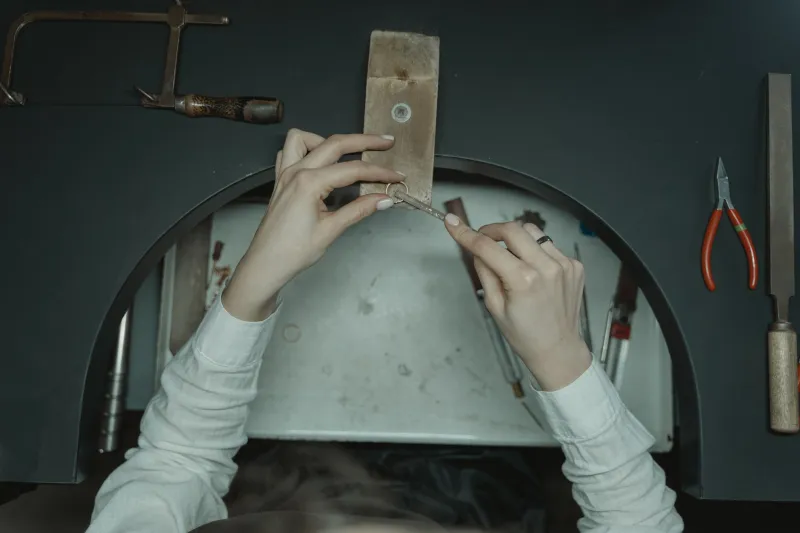
Look for a bench jeweller rather than a counter that sends everything away. Ask what will actually be done, who will do it and how long it will take. A written estimate should separate labour, metal and stones, and it should be clear whether the price includes reassembly, cleaning and any setting work. Ask for photographs before and after, and ask for old parts to be returned unless they are being replaced as part of a structural repair.
Where a repair involves adding metal, ask whether the piece will be submitted for assay and hallmarking if required. A reputable workshop will know the British rules rather than guess. Insurance is another useful signal: a workshop that handles higher-value pieces should be able to explain its cover. Location matters less than competence. Birmingham’s Jewellery Quarter and Hatton Garden remain deep benches of expertise, but many towns still have a good independent jeweller who can re-tip a claw or re-solder a chain without drama.
The honest arithmetic
Costs vary with metal, stone and complexity, but the ranges are not mysterious. At the time of writing, a straightforward re-solder on a fine chain commonly sits between £25 and £60; a new clasp £40 to £100; re-tipping a worn claw £35 to £75 per claw; a ring resize £50 to £120; and re-plating a costume piece £30 to £80. Restringing pearls might be £60 to £150, while rebuilding an inherited setting can begin around £150 and rise past £600 depending on metal and stones. Full restoration can exceed the market value of the piece, which is why the question should be what the object means, not merely what it is worth.
When a visible repair adds rather than detracts
A visible repair is not automatically a flaw. On antique and inherited pieces, a well-executed repair can read as part of the object’s history, especially when the alternative is a piece that cannot be worn. On contemporary fine jewellery, invisible repair is usually the better commercial choice. The distinction is between character and damage. A clean solder joint, a neatly replaced claw or a sympathetic new fitting can add to the story. A rushed repair that weakens the piece or disguises a larger problem does not.
Keep the paperwork. Invoices and photographs are useful for insurance, resale and family records. They also make the next repair easier. The mending mindset is not about romanticising wear. It is about making a clear-eyed judgement: mend what is sound, replace what is not, and treat the repair as part of the object’s continuing life rather than an admission of decline.