The Second Strand: A Considered Guide to Reworking Inherited Pearls in 2026
A pearl strand is one of the few pieces of jewellery that arrives with its own biography. It may have been worn to a wedding in the 1960s, kept for Sunday lunches, or left in a box because the clasp is awkward and the length feels municipal. In 2026, the more interesting British approach is not to retire these pieces to tissue paper but to ask what they could become. The mood is quiet luxury with a memory: pearls made wearable again, not preserved as evidence.
First, Separate Sentiment from Condition
Before any jeweller touches an inherited strand, it is worth understanding what you actually have. Pearls are organic, and their condition is not judged like metal. Look for dullness, flaking nacre, cracks around the drill holes, stretched or dirty silk, and a clasp that no longer holds securely. Freshwater pearls may be more forgiving; cultured saltwater pearls can be less so. A strand that has been stored near perfume, hairspray or central heating may have suffered quietly for years.
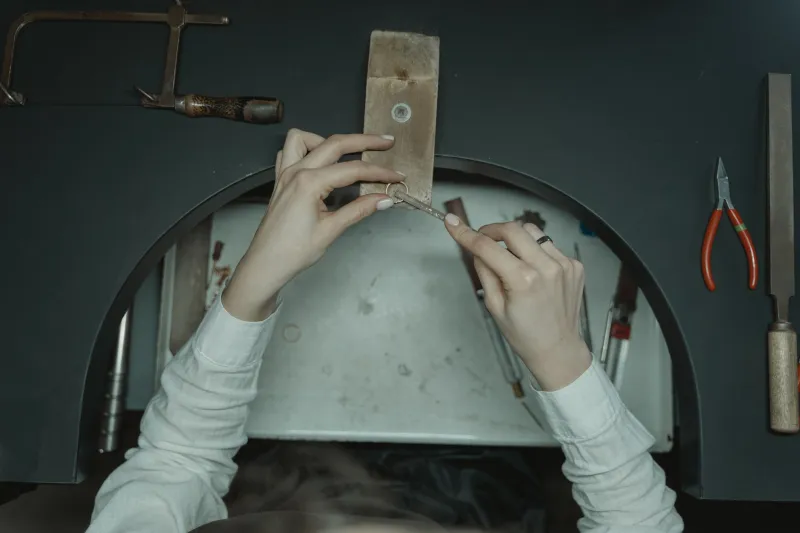
Ask a jeweller to assess the pearls under magnification and to check the silk rather than simply the surface. A professional will also note whether the strand is graduated, uniform or slightly irregular, and whether the clasp carries a maker’s mark or family initials. These details matter because they determine whether you are restringing a piece, repairing it, or beginning a redesign. The distinction is practical, but it is also emotional: the clasp may be the part everyone remembers.
Restringing Is Not a Lesser Choice
There is a tendency to assume that inherited jewellery must be transformed to be relevant. Often it does not. Restringing is the conservative, and sometimes the most respectful, option. It restores security, improves drape and allows the original sequence to remain intact. If the pearls are sound and the length suits you, restringing may be all that is required.
UK jewellers generally quote restringing by the inch or by the number of knots, with hand-knotting between pearls still the standard for a strand that should move properly. As a rough guide, a simple restring may begin around £60 to £120 for a short strand, though graduated work, matching thread, a new clasp or a longer necklace will push the figure higher. A full service on a significant strand can run into several hundred pounds. These are not extravagances if the alternative is a necklace that breaks at a dinner table.
Ask whether the jeweller will reuse the original clasp, source a period-appropriate replacement or fit something modern and secure. If the clasp is inscribed, keep it where possible. A good restring should preserve the character of the piece while making it fit for actual wear.
When Redesign Earns Its Place
Redesign becomes the better question when the strand is too short, too long, too formal or too damaged in part. The 2026 trend is not for dramatic reinvention but for intelligent editing: a long strand split into a collar and a bracelet, a double strand reduced to a single line with the surplus pearls made into drops, or a graduated necklace shortened and the remaining pearls set as earrings. The aim is to create pieces that enter the wardrobe rather than merely acknowledge the original.
A reputable jeweller will discuss proportion before design. Pearl size, neckline and daily wear matter more than a mood board. A short strand of larger pearls may suit a modern collar or a pair of substantial studs; smaller pearls often work better as a bracelet or a fine, layered chain. If the pearls are uneven, embrace that rather than forcing uniformity. The point is not to imitate a shop-bought strand but to make the inherited material feel deliberate.
Costs vary widely. Simple reassembly and restringing may sit at the lower end, while bespoke work involving new clasps, metal settings, CAD design or matching additional pearls can start around £250 and rise well beyond £900 depending on labour and materials. Ask for a written estimate that separates labour, findings and any new pearls. If a jeweller cannot explain the difference, keep looking.
The Questions to Ask Before Changing Anything
Sentimental jewellery carries family politics as well as material value. Before altering a piece, establish who else has a claim on it and whether anyone expects it to remain intact. If the strand was left to you outright, that is one matter; if it is held in trust or shared informally, another. A brief conversation now is cheaper than an argument later.
Ask yourself what must survive the change. Is it the pearls themselves, the clasp, the length, the colour or simply the fact of wearing something inherited? A jeweller can often preserve more than expected. Photograph the strand before work begins, keep any removed components, and request a written description of what will be reused. If the piece has a maker’s mark, ask that it not be polished away.
Finally, test the intended result against real life. Will you wear a short collar with the coats you own? Does a bracelet suit your working day? Are the earrings heavy enough to be uncomfortable? The most sustainable jewellery is not the most carefully preserved; it is the most often worn. A pearl strand that sits in a box is not being protected. It is simply paused.
In 2026, the reset is not about making pearls fashionable again. It is about making them yours. The best reworked strand will still carry the original occasion in its lustre, but it will also carry a newer, quieter purpose: a piece that leaves the house.