Spend Where It Shows: The Case for the £200 Jewellery Ceiling
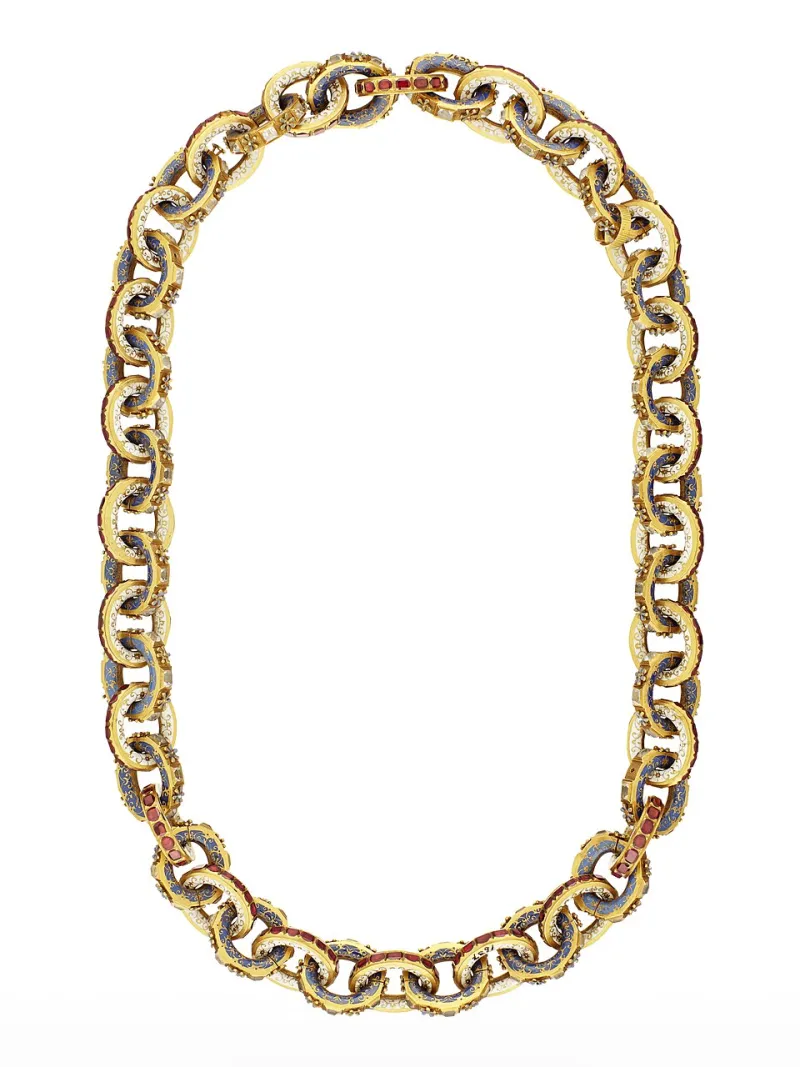
Photo: Unknown authorUnknown author, Public domain, via Wikimedia Commons
The £200 threshold is not a figure the jewellery trade invented. It is simply where most British shoppers stop browsing and start deliberating — and, as a consequence, where the design decisions become genuinely interesting. Below that line, the metal price dictates almost everything. Above it, carat weights, certificates and insurance valuations take over, and design often slips into second place. The ground in between is the most productive place in the UK market to spend an afternoon.
What £200 Actually Pays For
Begin with the arithmetic, because it explains most of what sits in the window. On a £200 retail price in 2026, VAT accounts for roughly £33. A retailer — whether a shop on a provincial high street or a website with a paid-acquisition budget to service — will take somewhere between £60 and £80. That leaves around £90 to £110 to cover metal, stones, labour, finishing, packaging and the assay office fee. It is not a generous sum, and every choice a maker makes at this level is a trade.
The practical consequence is that at £200 you are almost always buying a compromise, and the only useful question is which compromise has been made. A heavier chain and a thinner clasp. A larger stone and a lighter setting. More gold and less hand-finishing. The piece that suits you is the one whose compromise you can live with.
Three Tiers, Three Different Bets
The independent maker
Britain retains a dense network of small workshops: the upper floors of Hatton Garden, the Jewellery Quarter in Birmingham, pockets of Sheffield, Edinburgh and the Welsh borders. At £200 these makers are not selling you metal so much as time. You will often get sterling silver rather than gold, a lighter gauge, a smaller stone — but you will also get hand-finished edges, a properly set stone, a clasp chosen rather than sourced at the lowest price, and a name attached to the work. Repairs are usually possible and frequently carried out by the person who made the piece, which is a form of aftercare no multiple can match.
The high-street fine jeweller
The multiples that anchor most UK market towns work to a different brief. Their £200 buys predictability: 9ct gold or sterling silver, consistent sizing across branches, a guarantee, a returns policy and a hallmark you can verify. Production is typically CAD-led and cast in volume, which is why the finish is even and the detail is safe. Nothing here will surprise you, in either direction — and for a first piece of serious jewellery, that reliability has real value.
The designer fashion piece
The third tier generates most of the argument. At £200 a fashion house is selling design and a name. The metal is usually brass, the plating is rarely more than a few microns, and construction is often riveted or glued rather than soldered. That is not automatically a bad purchase. Some houses plate thickly and finish carefully, and a well-made base-metal cuff can outlast a thin silver one. But the buyer should understand what is being bought: the longevity sits in the design, not the material.
Where to Spend
Three categories repay the extra money almost every time.
- The chain. A chain is the hardest-working object in a jewellery box and the one most likely to fail. Solid links, a soldered jump ring and a proper lobster or box clasp are worth paying for; hollow links and spring rings are not.
- Anything that touches skin daily. Earring posts and backs in solid gold, or at minimum sterling silver, are a sensible premium for anyone with sensitive ears. Dermatitis from nickel is common and entirely avoidable.
- The setting. A stone held by four thick, well-soldered claws will survive a decade of knocks. A glued or bezel-set stone in a thin casting will not. This is where independent makers tend to win outright.
Where to Save
Be sceptical of coloured stones at this price. At £200, anything vivid is likely to be treated, dyed, glass-filled or synthetic, and some of those treatments are fragile under heat and cleaning. Be equally cautious with oversized statement earrings and trend-led shapes: they are worn a handful of times a season, and paying for solid gold in a shape you will retire by February is poor value.
Save, too, on anything decorative that sits at the back of the piece. Nobody has ever regretted a slightly plainer catch.
Reading the Hallmark
UK law is genuinely helpful here, and more shoppers should use it. Gold items above one gram and silver items above 7.78 grams must carry an independent assay office hallmark. Read the fineness mark: 375 for 9ct, 585 for 14ct, 750 for 18ct. A piece sold as gold without a hallmark at those weights is either misdescribed or imported irregularly.
Plating vocabulary matters as well. Gold vermeil conventionally means a sterling silver base with gold plating of at least 2.5 microns; standard gold plating over brass is often a fraction of that. Thickness, base metal and the maker's willingness to state both are the best indicators of how a piece will look in three years.
The Case for the Middle
The bargain and blue-chip extremes are, in their own ways, straightforward. At £40 you expect very little and are rarely disappointed. At £4,000 you are buying certified material and the price is anchored to a commodity. The £200 band is the only place where design, material and price are in genuine tension — which is why the UK's independent makers, and the better high-street ranges, are producing the most considered jewellery in the country right now.
A useful test before buying: divide the price by the number of wears you honestly expect. A £200 ring worn three times a week for five years costs about 26p a wear. A £200 pair of earrings worn twice costs £100. Buy fewer pieces; buy solid where the piece meets skin; buy plated where it does not. That rule will serve better than any carat count.